How to Set Your Rates as a Content Creator (And Invoice Accordingly)
Struggling to set rates for brand deals as an Indian creator? Learn how to price your services, negotiate confidently, and raise invoices that match your worth.
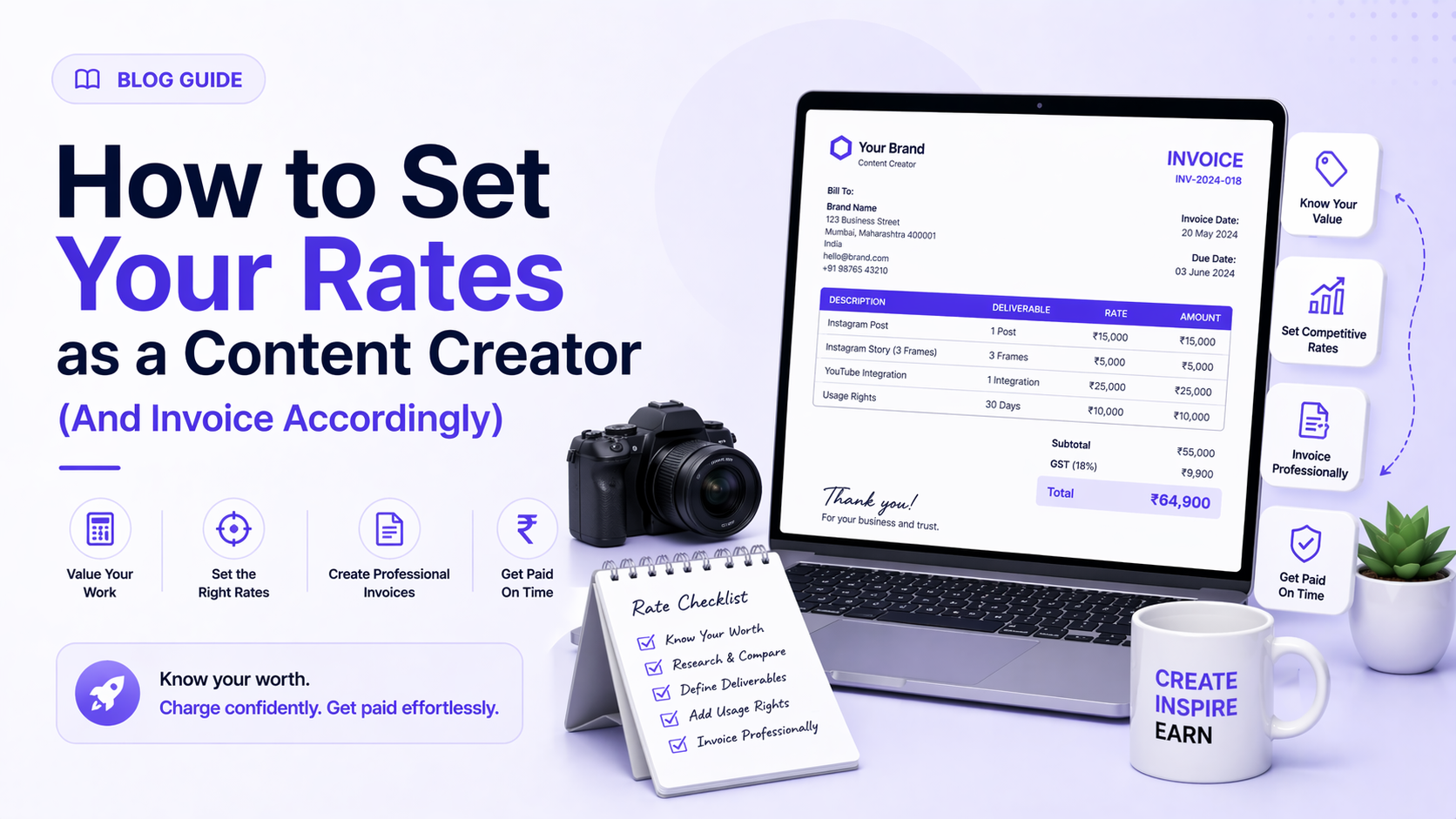
Introduction — Why Most Creators Are Undercharging
A brand approaches you with a campaign. They have a budget in mind — let's say ₹30,000. You have no idea if that's fair. You accept, because you don't want to lose the deal.
Three months later, a creator friend with a similar following tells you they charged the same brand ₹90,000 for the same deliverable.
This happens constantly in the Indian creator economy. Not because brands are dishonest — they will pay whatever they can get away with. But because creators don't have a systematic approach to pricing.
This guide changes that.
The Three Pricing Models Creators Use
Cost-Based Pricing
Calculate the actual cost of creating the content — your time, equipment depreciation, editing software, hired help — and add a profit margin. This is the most rational starting point but often undervalues reach and influence.
Market-Based Pricing
Research what other creators at your engagement level and niche are charging. Industry benchmarks exist (though they are rough guides, not rules). This gives you a competitive anchor.
Value-Based Pricing
Price based on the value you deliver to the brand — not your cost or the market rate. If a brand's average customer lifetime value is ₹5,000 and your reel is expected to convert 100 customers, the value delivered is ₹5,00,000. Charging ₹50,000 for that reel is a bargain for the brand.
Most established creators use a combination of market-based and value-based pricing, with cost-based as a floor.
Industry Benchmarks for Indian Creators in 2026
These are market reference ranges — actual rates vary significantly by niche, engagement rate, content quality, and brand budget.
|
Creator Tier |
Followers (Instagram) |
Instagram Reel (Typical Range) |
YouTube Integration |
|
Nano |
1K – 10K |
₹3,000 – ₹15,000 |
₹5,000 – ₹20,000 |
|
Micro |
10K – 100K |
₹15,000 – ₹75,000 |
₹20,000 – ₹1,00,000 |
|
Mid-Tier |
100K – 500K |
₹75,000 – ₹3,00,000 |
₹1,00,000 – ₹5,00,000 |
|
Macro |
500K – 1M |
₹3,00,000 – ₹7,00,000 |
₹5,00,000 – ₹15,00,000 |
|
Mega |
1M+ |
₹7,00,000+ |
₹15,00,000+ |
|
Important Note Engagement rate matters more than follower count. A micro-creator with 8% engagement rate often delivers better ROI for brands than a macro-creator with 1.2% engagement. Factor this into your pitch and pricing. |
Factors That Affect Your Rate
Niche Premium
Finance, tech, health, and B2B niches command significantly higher rates than entertainment or lifestyle — because brands in these sectors have higher customer acquisition costs and are willing to pay more for qualified leads.
Exclusivity
If a brand wants you to not work with competitors for a period, charge an exclusivity premium — typically 50-100% on top of the base rate for each month of exclusivity.
Usage Rights
Brands often want to repurpose your content in their own ads, website, or social media. Usage rights should be charged separately — typically 20-50% of the content creation fee per quarter of usage.
Deliverable Complexity
A 60-second reel with 3 days of shooting, professional editing, and original music costs more to produce than a talking-head review video. Be specific about what is included and charge accordingly.
Turnaround Time
Rush jobs (less than 5 business days) should carry a 25-50% premium. Your time has opportunity cost — express delivery has a price.
Building Your Rate Card
A rate card is a document that lists your standard deliverables and their corresponding prices. Having one makes negotiations faster and positions you as a professional.
Your rate card should include:
• Instagram: Reel (60 sec), Static Post, Story Pack (3), Carousel
• YouTube: Dedicated Video (10+ min), Integration (60-90 sec), Shorts
• Podcast: Dedicated Episode, Mid-roll Ad, Pre-roll
• Blog: Dedicated Review Post, Mention
• Exclusivity: Monthly rate
• Usage Rights: Quarterly rate
• Event Appearances: Per day / half-day
State clearly: 'All prices are exclusive of GST at 18%'. This is important — brands may assume your rate includes GST. Clarifying upfront avoids confusion at the invoice stage.
Negotiation — How to Hold Your Rate
Anchor High
Always quote 20-30% above your target rate. Brands almost always negotiate down. If you start at your target, you end below it.
Justify, Don't Apologise
When a brand pushes back on price, don't immediately lower it. Instead, justify it: share your engagement rate, past campaign results if available, audience demographics, and production quality. Brands with budget will pay — those without will ask for lower rates regardless of how you price.
Offer Alternatives Instead of Discounts
Rather than cutting your rate, offer a reduced scope: 'At ₹50,000 I can do the reel. The stories would be additional at ₹15,000.' This maintains your per-deliverable rate while giving the brand flexibility on budget.
Invoicing to Match Your Rates
Once a rate is agreed, your invoice must reflect it correctly to avoid disputes at payment time.
• Itemise every deliverable separately — do not lump everything into one line item
• State the rate per deliverable and the total before GST
• Add GST at 18% (IGST or CGST/SGST as applicable) on top
• Include the TDS clause if applicable
• State payment terms clearly (e.g., 'Payment due within 30 days of invoice date')
• Include your bank details and a payment link for faster collection
When a brand later disputes your invoice — 'We thought that included GST' or 'We didn't agree to that deliverable' — a detailed, itemised invoice is your protection. It creates a clear record of what was agreed and what you charged.
Frequently Asked Questions
Should I charge GST on top of my agreed rate or include it within?
Always charge GST on top of your agreed professional fee. Absorbing GST within your rate means you are effectively earning 15.25% less than agreed (18/118 = 15.25%). Make this clear in your rate card and confirm with brands before signing any agreement.
How do I handle barter-only deals in my rate card?
Barter deals should be valued at the fair market value of the product received, measured against your standard rates. If a brand offers a ₹5,000 product for a deliverable you normally charge ₹25,000, the barter deal is undervalued. Decline or negotiate additional compensation.
Can I charge different rates for different brands?
Yes — and you should. Larger brands with bigger marketing budgets should pay more. Your rate card is a starting point, not a fixed price list. Price based on the brand's category, budget signals, and the strategic value of the association.
What if a brand asks for a lower rate because I'm 'getting exposure'?
Exposure doesn't pay invoices. Evaluate whether the association genuinely has strategic value for your brand — being featured by a ₹500 crore brand in their communications might be worth a discount. A startup offering 'visibility' to their 2,000 followers is not.
Conclusion
Pricing is not just a financial decision — it is a statement about your professional value. Creators who know their worth, communicate it clearly, and invoice it correctly build more sustainable, higher-income businesses than those who accept whatever is offered.
Build your rate card, stick to it with confidence, and let your invoices reflect every rupee you have earned.
|
Create Your Invoice Use AdivoQ to create a detailed, itemised invoice for your brand deals in under 2 minutes — with GST auto-calculated and a payment link included. → adivoq.com/invoice-generator |
Written by
Super Admin
Sharing insights about invoicing, freelancing, and business growth to help creators succeed.
Ready to streamline your invoicing?
Join 2,000+ creators already using InvoiceHero to get paid faster.
Start Free Now