Do Influencers Need to Charge GST in India ?
Do influencers need to charge GST in India? Learn GST registration rules, rates, thresholds, barter taxation, and compliance requirements for creators in FY 2026-27.
Do Influencers Need to Charge GST in India? Complete Guide for FY 2026-27
You just got your first ₹50,000 brand deal. The brand asks — "Will you charge GST?"
You panic. You text your CA friend. You Google at 2 AM.
Let's end that confusion right now.
The short answer is — yes, most influencers earning serious money from brand collaborations must charge GST. But the details matter. Thresholds, state rules, barter deals, international payments — each has different rules.
This guide from Adivoq covers everything applicable for FY 2026-27 so you stay compliant and never lose a brand deal over tax confusion.
The Direct Answer: Do Influencers Need GST?
Yes. If your total annual income from all sources (brand deals, AdSense, affiliate commissions, paid promotions) exceeds ₹20 lakh, you must register for GST and charge 18% GST on your services. If you provide inter-state services (e.g., you're in Mumbai but the brand is in Delhi), GST registration is mandatory from ₹1 — no threshold applies.
That's the rule most creators miss. Let's break it down further.
GST Registration Thresholds for Influencers
| Scenario | Threshold | GST Mandatory? |
|---|---|---|
| Services within your own state | ₹20 lakh annual turnover | Yes, above this limit |
| Special category states (NE states, Himachal, Uttarakhand, J&K) | ₹10 lakh annual turnover | Yes, above this limit |
| Inter-state services (billing a brand in another state) | No threshold — ₹0 | Yes, from the first rupee |
| Selling on e-commerce platforms with TCS | No threshold | Yes, mandatory |
Why Inter-State Rule Matters Most
Here's what catches most influencers off guard:
You're a creator in Bangalore. A brand in Mumbai pays you ₹30,000 for one Instagram reel. Your annual income is only ₹3 lakh.
Do you need GST? YES.
Because the service crosses state boundaries, Section 24 of the CGST Act makes registration compulsory regardless of turnover. This is the rule that applies to 90% of Indian influencers — because brands and creators are rarely in the same state.
💡 Bottom line: If even ONE brand you work with is in a different state, you need GST registration. Period.
What GST Rate Do Influencers Charge?
The standard rate for influencer services is 18% under SAC Code 998361 (Advertising and Brand Promotion Services).
| Tax Type | When It Applies | Rate |
|---|---|---|
| CGST + SGST | Creator and brand in same state | 9% + 9% = 18% |
| IGST | Creator and brand in different states | 18% |
Example:
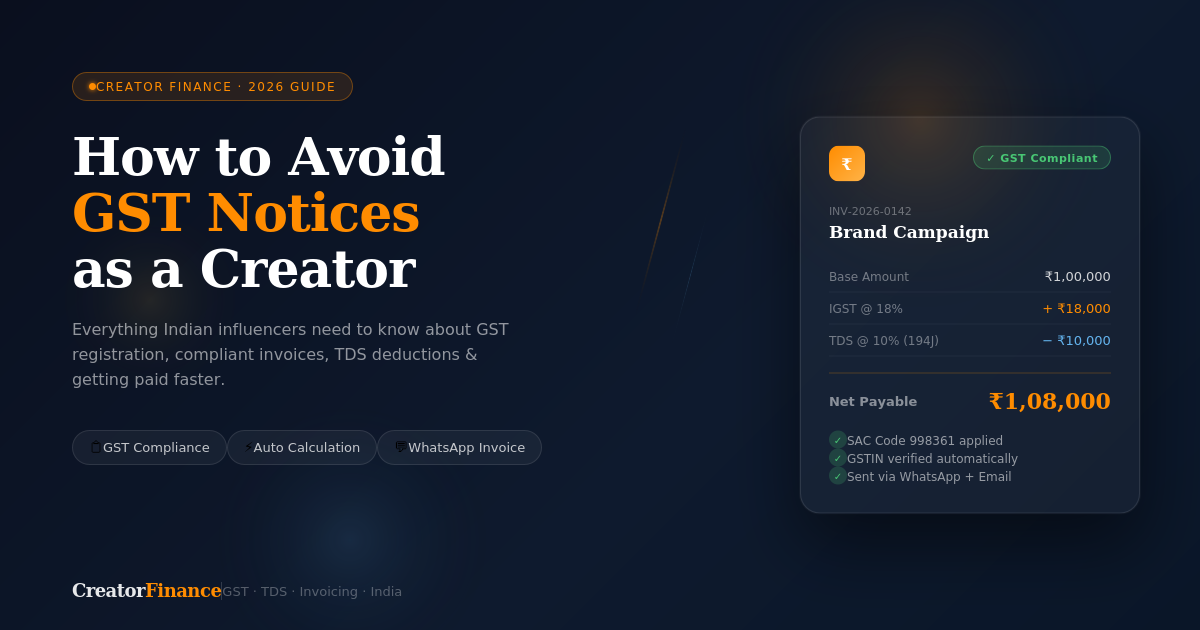
You charge a brand ₹1,00,000 for a campaign.
| Component | Amount |
|---|---|
| Service Fee | ₹1,00,000 |
| IGST @ 18% | ₹18,000 |
| Total Invoice | ₹1,18,000 |
The brand pays ₹1,18,000. You deposit ₹18,000 to the government through your GST return.
Need help creating this invoice correctly? Read our detailed guide: How to Create a GST-Compliant Invoice for Brand Collaborations in India
Which Income Sources Attract GST?
Creators earn from multiple streams. Here's what's taxable:
| Income Type | GST Applicable? | Rate |
|---|---|---|
| Sponsored Instagram/YouTube posts | ✅ Yes | 18% |
| Affiliate commissions | ✅ Yes | 18% |
| Brand event appearances | ✅ Yes | 18% |
| Consulting/strategy fees | ✅ Yes | 18% |
| Photography/videography services | ✅ Yes | 18% |
| Barter collaborations (gifted products) | ✅ Yes | 18% |
| YouTube AdSense (from Google Ireland) | ✅ Yes — but 0% with LUT (Export of Service) | 0% |
| Donations/tips from followers | ❌ Generally No | — |
The Barter Trap: Most Creators Don't Know This
A brand sends you a phone worth ₹60,000. You post a reel. No money changes hands.
Do you owe GST? Absolutely yes.
Under GST law, barter is treated as a supply of service. The taxable value is the open market value of the product received or the service provided.
GST payable = ₹60,000 × 18% = ₹10,800
You must pay this ₹10,800 to the government even though you received zero cash from the brand. This catches thousands of creators off guard every year.
What About International Brand Deals?
If a brand from the US, UK, or any other country pays you for content:
- It qualifies as Export of Services
- GST rate is 0% (zero-rated supply)
- You must file a Letter of Undertaking (LUT) on the GST portal — Form RFD-11
- Payment must be received in foreign currency
No LUT filed? You'll have to charge 18% IGST upfront and then claim a refund — which takes months. File your LUT proactively.
What Happens If You Don't Charge GST?
Ignoring GST isn't just risky — it's expensive.
| Consequence | Penalty |
|---|---|
| Not registering when required | ₹10,000 or 100% of tax due (whichever is higher) |
| Issuing invoice with GST but no GSTIN | Punishable under Section 122 |
| Not filing returns | ₹50/day (CGST) + ₹50/day (SGST) = ₹100/day late fee |
| Tax evasion | Up to 100% penalty + prosecution |
Beyond penalties, brands will stop working with you. Agencies run GSTIN verification before onboarding creators. No valid GSTIN = no deal.
Composition Scheme: Is It Right for Influencers?
| Parameter | Regular Scheme | Composition Scheme |
|---|---|---|
| Turnover Limit | No limit | Up to ₹50 lakh |
| GST Rate | 18% | 6% for services |
| Inter-state supply | ✅ Allowed | ❌ Not allowed |
| Input Tax Credit | ✅ Available | ❌ Not available |
Verdict: The Composition Scheme does not work for most influencers because it prohibits inter-state supply. Since most brand deals are inter-state, stick with the Regular Scheme.
How Adivoq Makes GST Compliance Effortless
Let's be real — you became a creator to create content, not to decode tax law.
Adivoq is built specifically for creators and freelancers who want to:
| Pain Point | How Adivoq Solves It |
|---|---|
| "I don't know whether to charge CGST+SGST or IGST" | Auto-calculates based on your state and brand's state |
| "Brands delay payments for weeks" | Send WhatsApp payment reminders directly to brand contacts |
| "I lose track of who owes me what" | Revenue analytics — track by brand, platform, campaign |
| "I need reports for my CA at tax time" | Download tax-ready reports — GST collected, TDS deducted, liability estimates |
| "Managing 10 brand deals in spreadsheets is chaos" | Brand & Campaign CRM — link invoices to specific deals |
| "I want brands to pay instantly" | Generate shareable payment links via Razorpay or Stripe |
Stop Googling GST rules at 2 AM. Let Adivoq handle the math while you focus on content.
Quick Action Checklist for Influencers
✅ Check if you provide inter-state services (if yes → register immediately)
✅ Register on gst.gov.in if turnover exceeds ₹20L or inter-state applies
✅ Use SAC Code 998361 for brand promotion services
✅ Charge 18% GST on every brand invoice
✅ Don't forget GST on barter deals
✅ File LUT if working with international brands
✅ File GSTR-1 and GSTR-3B every month/quarter
✅ Use Adivoq to automate invoicing and compliance
Frequently Asked Questions
Do influencers below ₹20 lakh turnover need GST?
Yes, if they provide inter-state services. The ₹20 lakh threshold only applies to intra-state (same state) services.
What is the GST rate for sponsored posts?
18% under SAC Code 998361.
Is GST charged on barter/gifted products?
Yes. GST at 18% applies on the open market value of the product or service exchanged.
Can influencers use the Composition Scheme?
Technically yes, but it's not recommended because it doesn't allow inter-state supply — which covers most brand deals.
What's the best invoicing tool for Indian influencers?
Adivoq — purpose-built for creators with auto GST calculation, WhatsApp reminders, payment links, and tax reports.
Written by
Super Admin
Sharing insights about invoicing, freelancing, and business growth to help creators succeed.
Related Articles
View all
Ready to streamline your invoicing?
Join 2,000+ creators already using InvoiceHero to get paid faster.
Start Free Now