How Indian Creators Can Avoid GST Notices in 2026
Are you an Indian content creator worried about GST notices? Learn how to stay GST-compliant, raise correct invoices, and get paid faster — without hiring a CA full-time.
Introduction
You just landed a ₹1,50,000 brand deal with a skincare brand. You're excited — and you should be. But then the brand's finance team emails you asking for a "GST-compliant invoice with SAC code and TDS clause."
Suddenly, the excitement turns into panic.
If this sounds familiar, you're not alone. Thousands of Indian creators — YouTubers, Instagram influencers, podcasters, and freelance writers — are earning significant income from brand collaborations, but very few know how to handle the compliance side correctly.
The bad news: the GST department is increasingly scrutinizing creators and influencers. The good news: staying compliant is far simpler than it sounds — especially with the right tools.
This guide breaks everything down in plain language.
What Is GST, and Why Should Creators Care?
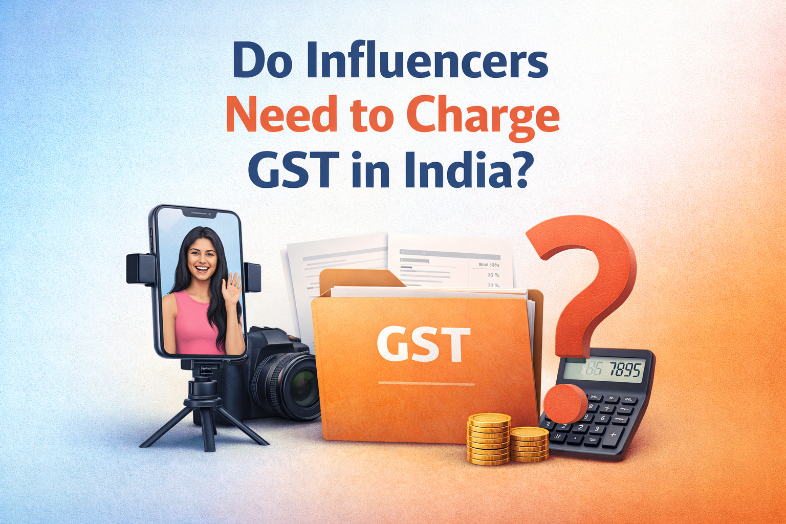
GST (Goods and Services Tax) is an indirect tax levied on the supply of goods and services in India. As a content creator, when you provide services to a brand — like making a sponsored reel, writing a review, or appearing in an ad campaign — you are technically providing a taxable service.
That means you may be required to:
- Register for GST
- Charge GST on your invoices
- File GST returns regularly
- Maintain proper records
Ignoring this isn't just risky — it can result in notices, penalties, and even retrospective tax demands.
When Does a Creator Need to Register for GST?
Q: Do all influencers need to register for GST?
No — but the threshold matters.
| Annual Turnover | GST Registration Required? |
|---|---|
| Below ₹20 lakhs (most states) | No |
| Above ₹20 lakhs | Yes — mandatory |
| Below ₹10 lakhs (special category states like J&K, Manipur, etc.) | Yes — lower threshold applies |
Important exception: If you receive income from brands located outside India (international brand deals), GST registration is mandatory regardless of your turnover — even if you earn just ₹1 from a foreign brand. This falls under the category of export of services, but registration is still required.
Also note: if you are registered under GST voluntarily or mandatorily, you must charge GST on all your invoices — you cannot selectively apply it.
What GST Rate Applies to Creator Services?
Q: What is the GST rate for influencers and content creators?
Most creator services fall under 18% GST — specifically under the category of "Other Professional, Technical and Business Services" with SAC (Services Accounting Code) 998361 or 998313 depending on the nature of work.
Here's a quick reference:
| Type of Work | SAC Code | GST Rate |
|---|---|---|
| Brand promotion / influencer marketing | 998361 | 18% |
| Content creation (video, photography) | 998313 | 18% |
| Social media management | 998313 | 18% |
| Event appearances | 999321 | 18% |
Barter deals (gifted products): If a brand gives you a free product in exchange for a post, the fair market value of that product is taxable. Many creators don't know this and get caught off-guard.
CGST vs SGST vs IGST — Which One Applies to You?
This is where most creators make mistakes on invoices.
- CGST + SGST applies when you and the brand are in the same state. Each is 9% for a total of 18%.
- IGST applies when you and the brand are in different states. It is 18% flat.
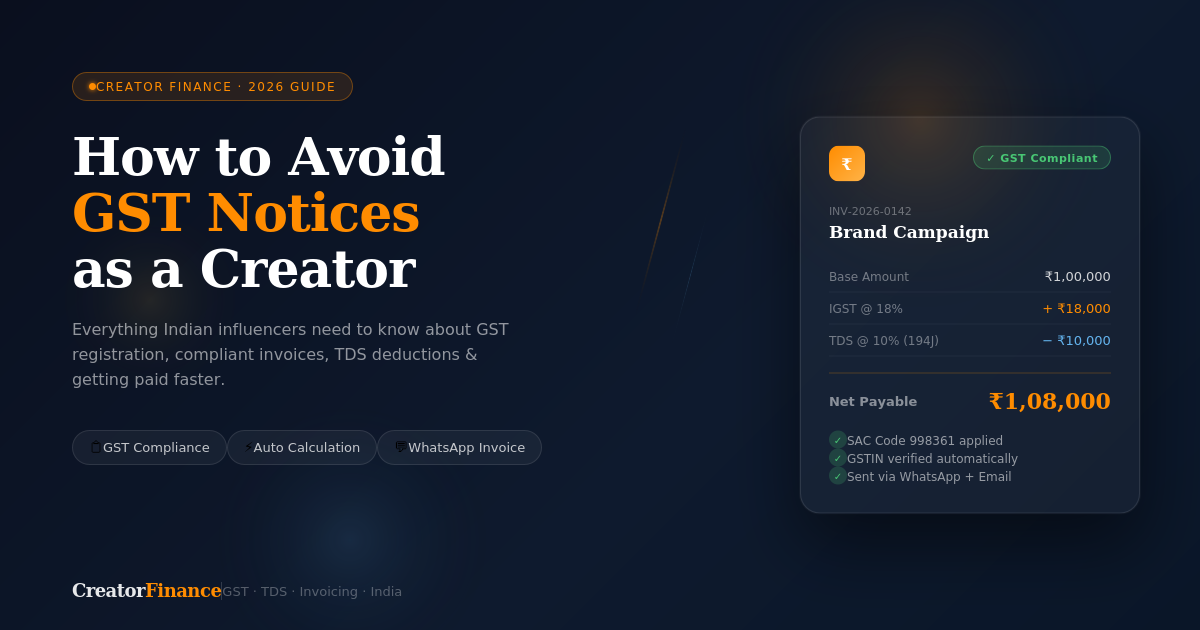
Example: You're a creator based in Mumbai (Maharashtra). The brand's billing address is in Delhi. → Apply IGST @ 18%
If the same brand has a Mumbai office and bills from there: → Apply CGST @ 9% + SGST @ 9%
Getting this wrong means your invoice is technically non-compliant — and the brand's finance team may reject it or delay payment.
Tools like AdivoQ automatically detect whether to apply CGST/SGST or IGST based on your state code and the brand's GSTIN. You never have to do this manually.
What Is TDS, and How Does It Affect Creator Payments?
Q: What is TDS for content creators in India?
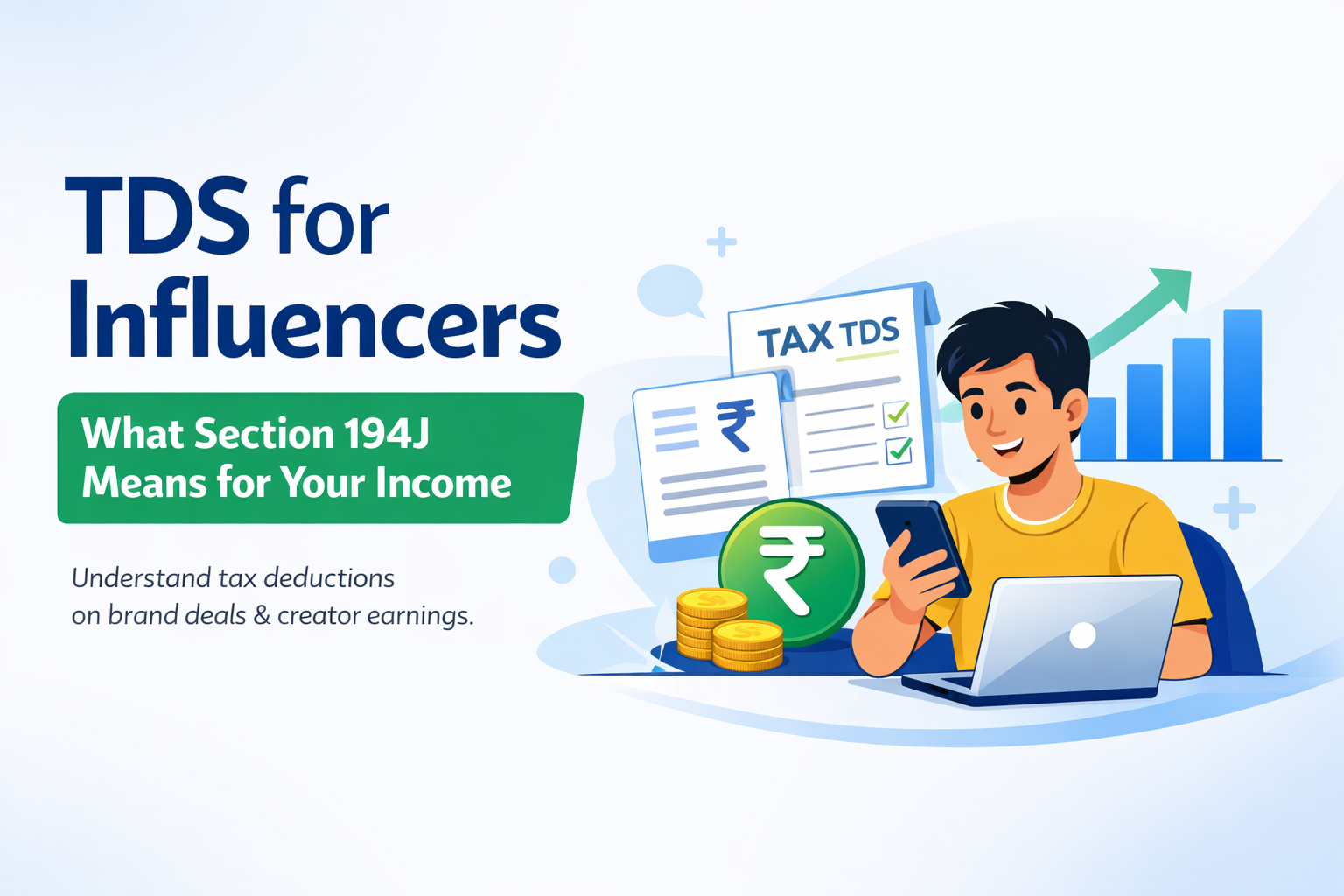
TDS stands for Tax Deducted at Source. When a brand pays you above a certain threshold, they are legally required to deduct a percentage of your payment as TDS and deposit it with the government on your behalf.
For creators providing professional services, TDS under Section 194J applies at 10% if your annual income from that payer exceeds ₹30,000.
Example: You invoice a brand for ₹1,00,000. They deduct TDS of ₹10,000 (10%). You receive ₹90,000 in your account.
The ₹10,000 is deposited to the government and reflects in your Form 26AS as advance tax paid. You claim it when filing your ITR.
On your invoice, always mention: "TDS @ 10% applicable under Section 194J" — this signals to the brand's finance team that you're aware of the rules and helps speed up payment processing.
The 5 Most Common GST Mistakes Creators Make
1. Not registering even after crossing the threshold Many creators cross ₹20 lakhs in annual income across multiple brands but don't realize they needed to register. Retrospective registration can result in penalties.
2. Using wrong SAC codes Wrong SAC codes create reconciliation issues in the brand's GSTR-2A. The brand may flag your invoice as non-compliant.
3. Charging GST but not filing returns Collecting GST and not filing GSTR-1 and GSTR-3B is a serious offense. The tax collected must be remitted to the government.
4. Ignoring barter deals That ₹50,000 camera a brand gifted you? It's taxable income — both for income tax and potentially GST purposes.
5. No invoice numbering system The GST Act requires invoices to be sequentially numbered. Random invoice numbering can trigger scrutiny.
What a GST-Compliant Invoice for Creators Must Include
Q: What should a creator's GST invoice contain?
Every invoice you raise should have:
✅ Your legal name and GSTIN
✅ Brand's name and GSTIN
✅ Unique sequential invoice number
✅ Date of invoice
✅ Description of services (with SAC code)
✅ Amount before GST
✅ CGST/SGST or IGST clearly broken out
✅ TDS clause (if applicable)
✅ Bank account details for payment
✅ Place of supply (your state)
Missing even one of these elements can result in the brand rejecting your invoice or the GST department questioning the transaction.
How AdivoQ Makes All of This Effortless
Manually handling all of the above on a Google Doc or Excel sheet is not just time-consuming — it's error-prone.
AdivoQ is built specifically for Indian content creators to handle every one of these compliance requirements automatically:
- Auto GST calculation — detects CGST/SGST vs IGST based on state codes
- SAC code library — select the right code from a built-in list
- TDS field — add TDS deduction with one click, it auto-adjusts the net payable
- Sequential invoice numbering — automatic, GST-compliant
- WhatsApp delivery — send invoices directly to brand finance teams on WhatsApp
- Payment links — collect payments via Razorpay or Stripe, reducing follow-up
- Tax reports — download a complete GST summary for your CA before every filing
The free plan covers 5 invoices/month — enough for most new creators to get started without spending anything.
Frequently Asked Questions
Q: Can I raise an invoice without GST if I'm below the threshold? Yes. If your annual turnover is below ₹20 lakhs, you don't need to charge GST. Simply raise a regular invoice without GST — but mention "GST Not Applicable — Below Threshold" to keep things clean.
Q: What happens if I forgot to charge GST on old invoices? If you were registered but didn't charge GST, you may still be liable to pay it from your own pocket. Consult a CA and voluntarily disclose if needed.
Q: Do I need to file GST returns every month? If your turnover is below ₹5 crores, you can opt for the QRMP scheme (Quarterly Returns with Monthly Payments), which reduces the filing burden significantly.
Q: Is barter income really taxable? Yes. CBIC has clarified that influencers receiving free products in exchange for promotion must treat the fair market value as taxable supply.
Q: How do I find my brand's GSTIN? Ask the brand's marketing or finance team. You can also verify it on the official GST portal (gst.gov.in) using the brand's company name.
Conclusion
GST compliance for creators isn't optional anymore — the creator economy in India is too large and too visible to fly under the tax radar. The good news is that with the right systems in place, compliance takes minutes, not hours.
Whether you're a nano-creator just crossing ₹20 lakhs or a full-time YouTuber managing 20+ brand deals a year, getting your invoicing right protects you legally, builds trust with brands, and — most importantly — gets you paid faster.
Ready to raise your first GST-compliant invoice in under 2 minutes? Try AdivoQ Free — No Credit Card Required →
Written by
Super Admin
Sharing insights about invoicing, freelancing, and business growth to help creators succeed.
Related Articles
View all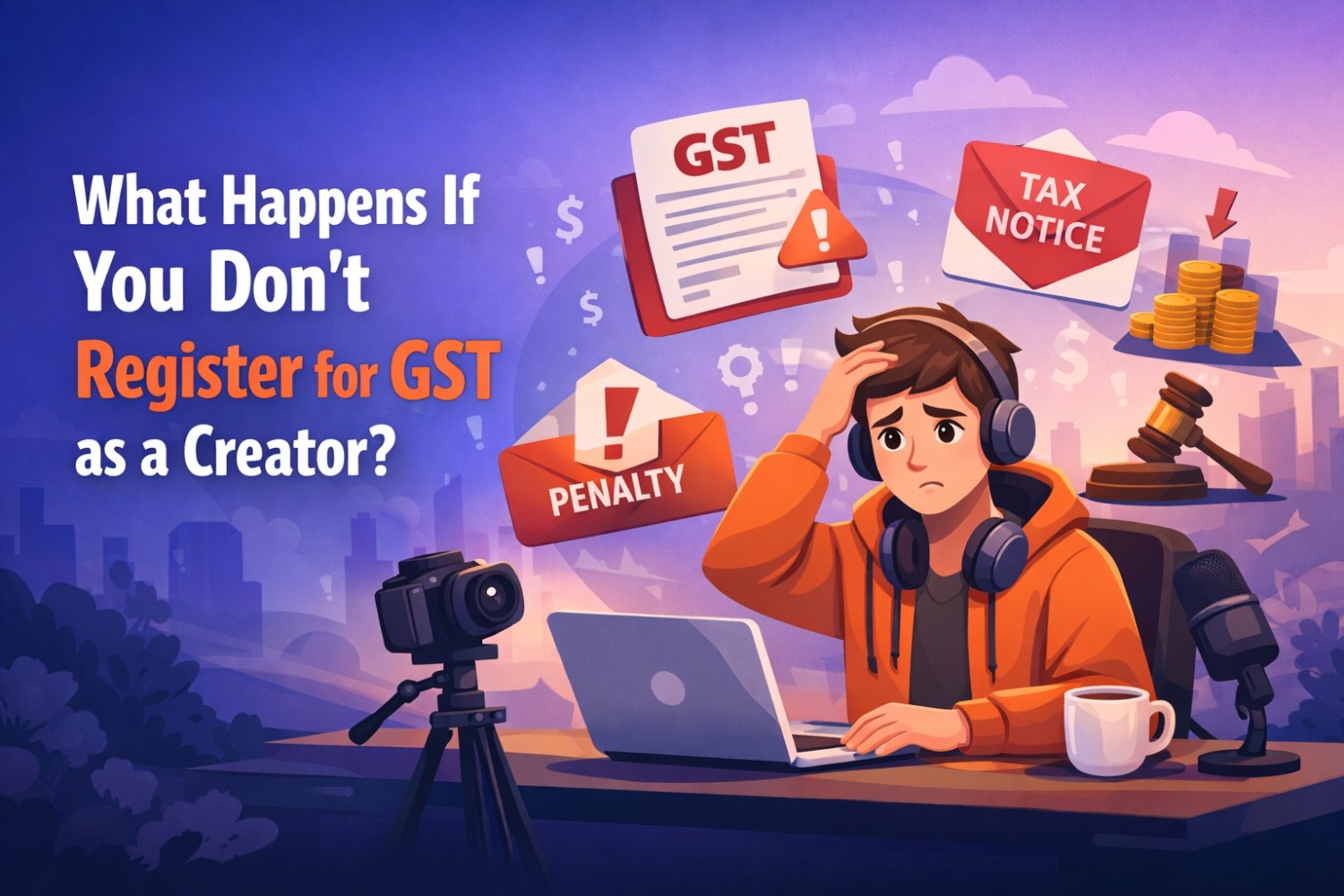
Ready to streamline your invoicing?
Join 2,000+ creators already using InvoiceHero to get paid faster.
Start Free Now