TDS for Influencers: What Section 194J Means for Your Income
Confused about TDS deductions on your brand payments? Learn how Section 194J applies to Indian influencers, how to read Form 26AS, and how to claim TDS refunds when filing ITR.
Introduction
You invoice a brand for ₹80,000. They pay you ₹72,000.
You're confused — did they short-pay? Did something go wrong? You follow up. The finance team replies: "We deducted TDS @ 10% under Section 194J. You'll get a certificate."
And then you're even more confused.
This scenario plays out thousands of times a month across India's creator economy. TDS — Tax Deducted at Source — is one of the most misunderstood parts of being a professional content creator or influencer in India. Many creators think they're being underpaid. Some never claim it back. Others don't even know it shows up in their tax records.
This guide explains everything clearly — what TDS is, how it works, why brands deduct it, and most importantly, how you can claim it back or use it to reduce your tax bill.
What Is TDS, and Why Do Brands Deduct It?
TDS stands for Tax Deducted at Source. It is a mechanism where the person making a payment deducts a portion of that payment as tax and deposits it with the government — on behalf of the person receiving it.
Think of it as advance income tax — collected at the point of payment rather than at the end of the year.
The government introduced TDS to:
- Ensure taxes are collected in real time (not just during ITR filing season)
- Reduce tax evasion
- Create an audit trail between payers and receivers
When a brand pays you for a sponsored post, YouTube integration, or any professional service, they are legally required under the Income Tax Act to deduct TDS before releasing payment — if you cross a certain threshold.
This is not the brand being difficult. It is the law.
Which Section of the Income Tax Act Applies to Creators?
Q: Under which section is TDS deducted for influencer payments?
For content creators and influencers, TDS is most commonly deducted under Section 194J — which covers fees for professional or technical services.
Here is a quick overview of the key sections that may apply:
| Section | Applies To | TDS Rate |
|---|---|---|
| 194J | Professional/technical fees (content creation, brand consulting) | 10% |
| 194C | Contractor payments (production, video editing services) | 1% (individual) / 2% (company) |
| 194H | Commission or brokerage | 5% |
| 194A | Interest income | 10% |
For most creators doing brand deals, sponsored content, ambassador roles, voiceovers, script writing, and social media campaigns — Section 194J at 10% is the applicable rate.
Some brands may incorrectly deduct under 194C (contractor rate of 1-2%). While this benefits you in the short term, it can cause mismatches during tax filing. Always clarify with the brand which section they are deducting under.
When Is TDS Actually Deducted?
Q: Is TDS deducted on every payment from a brand?
No — TDS is only deducted when your payment from a single payer crosses ₹30,000 in a financial year (April to March).
| Payment Amount (from one brand in a year) | TDS Applicable? |
|---|---|
| Below ₹30,000 | No TDS |
| ₹30,001 and above | Yes — 10% on entire amount |
Important: The ₹30,000 limit is per payer, not total income. So if Brand A pays you ₹25,000 and Brand B pays you ₹25,000 — neither needs to deduct TDS. But if Brand A pays you ₹50,000 total across two invoices — TDS applies to the entire ₹50,000.
Also note: If you do not provide your PAN to the brand, TDS is deducted at 20% instead of 10%. Always share your PAN card details when onboarding with a new brand.
How TDS Works: A Real Example
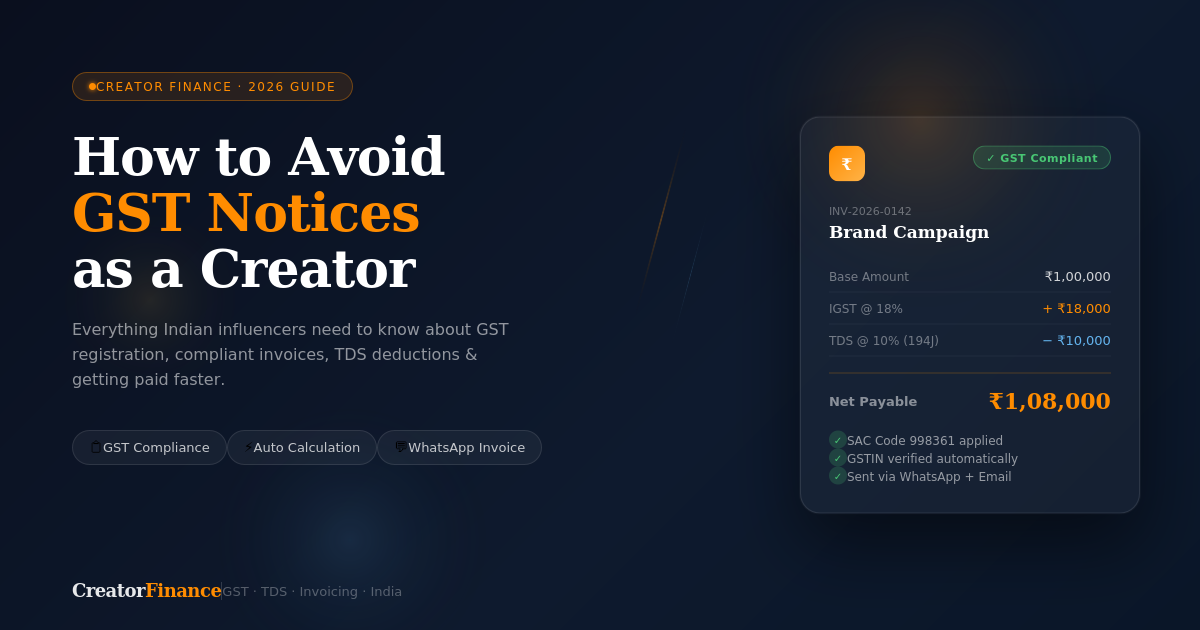
Let's say you do a campaign with a skincare brand and raise an invoice for ₹1,00,000 + 18% GST.
Here is how the math works:
| Line Item | Amount |
|---|---|
| Professional Fee (Base) | ₹1,00,000 |
| GST @ 18% (IGST) | ₹18,000 |
| Gross Invoice Total | ₹1,18,000 |
| TDS @ 10% on base (not on GST) | − ₹10,000 |
| Net Amount You Receive | ₹1,08,000 |
Two critical points here:
- TDS is deducted on the base amount only — not on GST. Many brands (and creators) get this wrong. GST is a pass-through tax and should not be part of the TDS calculation.
- The ₹10,000 deducted is not lost money. It is deposited with the government as advance tax on your behalf. You will get credit for it when you file your ITR.
What Is Form 26AS and Why Should You Check It?
Q: How do I verify TDS deducted on my payments?
Every rupee of TDS deducted against your PAN is recorded in Form 26AS — a consolidated tax statement maintained by the Income Tax Department.
Think of it as your tax passbook. It shows:
- Who deducted TDS from your income
- How much was deducted
- Whether it has been deposited with the government
- The quarter in which it was deducted
You can access Form 26AS by logging into the Income Tax e-filing portal (incometax.gov.in) → My Account → View Form 26AS.
Why this matters: When you file your ITR, you claim TDS credit based on what appears in Form 26AS. If a brand deducted TDS but did not deposit it (which unfortunately happens), it won't show up — and you won't get credit for it. Checking 26AS every quarter protects you from this.
TDS Certificate — Form 16A
After deducting TDS, brands are legally required to issue you a Form 16A — a TDS certificate that details:
- The brand's name and TAN (Tax Deduction Account Number)
- Your PAN
- Amount paid
- TDS deducted and deposited
- Quarter in which it was deposited
You should receive Form 16A within 15 days of the end of the quarter in which TDS was deducted:
| Quarter | Period | Form 16A Due By |
|---|---|---|
| Q1 | April – June | 15th August |
| Q2 | July – September | 15th November |
| Q3 | October – December | 15th February |
| Q4 | January – March | 15th June |
If a brand delays issuing Form 16A, you can request it formally in writing. The data should still appear in your Form 26AS regardless.
How to Claim TDS Credit When Filing Your ITR
Q: How do I get my TDS money back?
When you file your Income Tax Return, the total TDS deducted across all brands is automatically credited against your tax liability.
Here is how it plays out:
Scenario 1 — Your tax liability is less than TDS deducted: You get a refund. The excess TDS is returned to your bank account by the IT department, usually within 20-45 days of filing.
Scenario 2 — Your tax liability is more than TDS deducted: You pay the remaining balance as self-assessment tax before filing.
Scenario 3 — You are in the 0% tax slab: If your total income (after deductions) is below ₹3,00,000 (old regime) or ₹7,00,000 (new regime after rebate), your tax liability is nil — and all TDS deducted gets refunded in full.
Filing tip: Always select the correct ITR form. Most creators with multiple income sources (brand deals + AdSense + affiliate) should file ITR-3 (business income) or ITR-4 (presumptive taxation under 44ADA if you qualify). Filing under the wrong form can delay your refund or trigger scrutiny.
Can You Avoid TDS Deduction? Lower Deduction Certificate
If you expect your total tax liability for the year to be significantly lower than the TDS that will be deducted, you can apply for a Lower Deduction Certificate (LDC) under Section 197.
This allows brands to deduct TDS at a lower rate — sometimes even 0% — based on your projected income and tax liability.
To apply, you need to:
- Log in to the IT portal
- Submit Form 13 with projected income details
- Get a certificate issued by your Assessing Officer
- Share this certificate with every brand before they make payments
This is particularly useful for creators earning ₹15-30 lakhs annually, where TDS deductions can be significant and refunds can take months.
Common TDS Mistakes Creators Make
1. Not sharing PAN with the brand Results in TDS at 20% instead of 10%. Always share your PAN when signing a brand deal.
2. Including GST in the TDS calculation TDS applies on the base fee only — not on GST. If a brand deducts TDS on the GST component too, raise it with their finance team.
3. Not checking Form 26AS Trusting that TDS was deposited without verifying. Brands do default — always check before filing.
4. Not claiming TDS in ITR Some creators forget to claim TDS credit, resulting in overpaying taxes. Your CA should reconcile Form 26AS with your income during filing.
5. Confusing TDS with GST TDS is an income tax concept. GST is indirect tax. They are completely different systems. TDS reduces what you receive; GST is collected on behalf of the government and passed on.
How to Mention TDS on Your Invoice
A GST-compliant invoice should clearly mention the TDS clause so the brand's finance team knows what to deduct. Here is the recommended wording to add to your invoice footer:
"TDS @ 10% is applicable on professional fees under Section 194J of the Income Tax Act. Please deduct TDS on the base amount only (excluding GST). PAN: [Your PAN]"
This removes ambiguity, speeds up payment processing, and ensures the brand deducts the correct amount.
Tools like AdivoQ let you add this as a one-click field directly on your invoice — the TDS amount auto-calculates and the net payable updates instantly, so there's no back-and-forth with brand finance teams.
Frequently Asked Questions
Q: Does TDS apply to barter deals or gifted products? TDS typically applies to monetary payments. For pure barter deals (product only, no cash), TDS is generally not deducted — however, the fair market value of the product is still taxable as your income.
Q: What if the brand doesn't give me Form 16A? The data should still appear in your Form 26AS if TDS was deposited. You can file your ITR using Form 26AS data directly. Sending a formal email requesting Form 16A is advisable.
Q: I received less money than invoiced. How do I know if it's TDS or a short payment? Ask the brand for the payment breakdown. TDS deductions must be disclosed. If TDS was deducted, they should share the amount and the section under which it was deducted within a reasonable time.
Q: Can foreign brands deduct TDS? Foreign entities making payments to Indian residents may deduct TDS under Section 195 instead of 194J. However, many foreign brands (Google AdSense, Meta, YouTube) do not deduct Indian TDS — that responsibility may fall on you to pay as advance tax.
Q: What is the penalty for brands that don't deposit TDS? The brand is liable for interest at 1.5% per month and penalties. However, you — the creator — may still be able to claim credit if the TDS is eventually deposited. This is why tracking Form 26AS is essential.
Quick Reference Summary
| Topic | Key Detail |
|---|---|
| Applicable Section | 194J (Professional Fees) |
| TDS Rate | 10% |
| Threshold | ₹30,000 per payer per year |
| TDS on GST? | No — base amount only |
| Without PAN | 20% TDS |
| Verification | Form 26AS |
| Certificate | Form 16A (within 15 days of quarter end) |
| Recovery | Claim in ITR as advance tax paid |
Conclusion
TDS is not the enemy — it is advance tax working in your favour, provided you understand how to track it and claim it back. The real danger is not knowing: missing TDS credits, filing under the wrong ITR form, or failing to reconcile Form 26AS can cost you both money and peace of mind.
Once you know the rules, the process becomes straightforward. Raise compliant invoices with the right TDS clause, check your Form 26AS every quarter, and work with a CA during filing season to ensure every rupee of TDS is credited properly.
Want invoices that automatically calculate TDS, adjust net payable, and remind brands to pay on time? Try AdivoQ Free — No Credit Card Required →
Written by
Super Admin
Sharing insights about invoicing, freelancing, and business growth to help creators succeed.
Related Articles
View all
Ready to streamline your invoicing?
Join 2,000+ creators already using InvoiceHero to get paid faster.
Start Free Now